
Taichung's Shizheng Road Project: An Engine for Urban Development and a New Impetus for the Economy and Real Estate
Analyzing the Needs, Implementation, and Future Prospects of the Shizheng Road Extension and Optimization Project, and Its Profound Impact on the Regional Economy and Property Market
By Rehoboth |
What Topics Will Be Inside?
Taiwan's Future Indicative Construction Following the in-depth analysis of Taichung's indicative construction in the previous article, Taiwan's overall future construction pattern presents a more macro development vision. Under the strategic guidance of the Lai Qingde government's "National Hope Project", Taiwan is moving towards the 2030 vision, and through the three core values of innovation, inclusiveness, and sustainability, it is comprehensively promoting the country's modernization transformation. The continuous advancement of forward-looking infrastructure 2.0 Rail construction network Taiwan's rail construction is focusing on forward-looking infrastructure projects and continuing to build a transportation network across the island. Under the plan with a total investment of NT$424.133 billion, it covers 38 rail construction projects in five major axes, including "connecting high-speed rail and Taiwan Railway into a network", "upgrading Taiwan Railway and improving services in the east", "three-dimensional railways or speeding up commuting", "promoting MRT in urban areas", and "sightseeing railways in central and southern Taiwan". Key projects include the Hualien-Taitung railway double-track electrification project (NT$41.067 billion), the Taoyuan metropolitan railway underground project (NT$96.409 billion), the Tainan urban railway underground project (NT$29.360 billion), and multiple MRT projects such as the Taoyuan MRT Green Line (NT$98.264 billion). These projects will be completed in succession from 2025 to 2030, greatly improving Taiwan's overall transportation efficiency. Innovative development of green energy construction Taiwan's green energy construction is moving towards the goal of 20GW of solar photovoltaic power and 6.7GW of wind power by 2030. Among them, priority is given to promoting rooftop solar energy of 8GW, including agricultural facility roofs, industrial roofs, public roofs and private roofs; ground-based solar energy is promoted to 12GW, focusing on the revitalization of idle public land, unfavorable agricultural land and land compound utilization. In terms of wind power construction, the government has built Taiwan's wind farms with international competitiveness, and built underwater foundations and heavy-duty docks such as the Kaohsiung Marine Technology Industry Innovation Zone and the Taichung Port Offshore Wind Power Industry Zone. In addition, Shalun Smart Green Energy Science City will build an innovative green energy industry ecosystem and become a demonstration and verification field for the industrialization of green energy technology. National Development Plan (2015-2018) Economic Development Goals According to the four-year national development plan formulated by the National Development Council, Taiwan has set a target of an economic growth rate of 2.80% to 3.60% and a per capita GDP of US$39,105 to US$42,787 from 2025 to 2028. It is particularly noteworthy that Taiwan's per capita GDP is expected to surpass South Korea from 2025 and continue to widen the gap with Japan and South Korea; per capita GDP is expected to exceed US$40,000 in 2027; and Taiwan's nominal GDP will be close to US$1 trillion in 2028.
Development of five major trust industries The government will develop five major trust industries, setting goals such as an additional output value of 2.6578 trillion yuan for semiconductors, an output value of more than one trillion yuan for AI in 2026, an output value of more than 130 billion yuan for security and information security, an output value of 30 billion yuan for satellite communications, and an output value of 30 billion yuan for military drones. These industries will become important engines for Taiwan's future economic development. Strategic layout of the space industry Satellite development plan Taiwan's space industry is advancing with a positive momentum, demonstrating its outstanding technical strength and strong independent research and development capabilities. Formosat-8 continues the mission of Formosat-5 and consists of 6 "pioneer high-resolution optical telemetry satellites" and 2 "ultra-high-resolution intelligent telemetry satellites". It is expected to be launched between 2025 and 2031, and the satellite components will reach a self-made rate of 60-70% by the end of 2024. Formosat-9 is a synthetic aperture radar satellite with a resolution of 0.5 to 0.7 meters. It is planned to be launched in 2027 and 2029. As Taiwan's first self-made meteorological satellite, TRITON marks the independent development of Taiwan's space technology. Construction of low-orbit communication satellites Taiwan is actively promoting the low-orbit communication satellite project, initially planning a 2+4 configuration, and co-developing with the Industrial Technology Research Institute and domestic and foreign industries. In terms of satellite integration and testing capabilities, Taiwan has made great progress in satellites below 1,000 kilograms, and has complete independent capabilities in system and subsystem design and manufacturing. Smart cities and digital transformation Self-driving car technology development Taiwan has completed the preparations for the development of the self-driving car industry in terms of regulations, funding, infrastructure, and talent. Through the advantages of the ICT industry, from components, subsystems to system integration, training opportunities have been established in places such as Shalun, Tainan and Hutoushan, Taoyuan. Local governments are actively creating a self-driving car testing environment. Unmanned minibuses in Taipei City have been piloted on the Xinyi Road bus lane. Kaohsiung City has introduced the first unmanned minibus in Taiwan. Taoyuan City has established the "Hutoushan Internet of Things Innovation Base", which is expected to match 50 groups of companies and connect 6.6 billion yuan in new venture capital. Smart medical innovation Taiwan's second phase of smart medical plan (2024-2027) focuses on two major themes: smart clinical decision support and GenAI/smart hospital management, covering 9 system modules such as cardiovascular disease diagnosis and treatment, lung cancer auxiliary diagnosis and treatment, and brain injury awareness monitoring.
The plan will expand from single-point applications to integrated applications, create a complete clinical application solution, and combine chips, home medical care and medical robots to extend medical center-level services to individuals and homes. Major regional development and construction Taoyuan Aviation City Development Taoyuan Aviation City is a national-level development project with a total area of 4,564.26 hectares, including the airport park (egg yolk area) and nearby areas (egg white area). Taiwan Life Insurance bid for Aviation City I Base with NT$13.7 billion, and jointly planned and built hotels, commercial offices and storage facilities with Yunbao Energy. The total investment is expected to reach NT$52 billion. The area of Aviation City section acquisition is 3,148.17 hectares, and nearly 75% of the land is acquired through section acquisition. It is planned to build 1,924 resettlement houses, ranging from 25 ping to 55 ping. Construction of the Tamsui New Town The Danjiang Bridge is expected to be completed by the end of 2025 and open to traffic in 2026. It will cross the Tamsui River and connect Tamsui to Bali, directly to the Xinban Special Zone, 26 minutes to Taoyuan Airport, and 29 minutes to Taipei Main Station. The second phase of the Blue Sea Line is expected to be completed in 2030, with 6 stations connecting from Tamsui Fisherman's Wharf to the square behind Tamsui Station. Zhongli Sports Park and Dome Project Taoyuan Mayor Chang Shan-cheng announced at the completion and opening ceremony of the Zhongli Sports Park section that a new dome stadium will be planned and built. The sports park is located in the prime area behind Zhongli Station, with a total area of 72.97 hectares, covering multiple uses such as residential areas, sports areas, and commercial areas. The 3 billion yuan section acquisition and development has been completed. National Land Planning Act and Spatial Planning National Land Zoning Management Although the implementation of the National Land Planning Act has been postponed to 2031, it has divided the country's land into four functional zones: land conservation areas, marine resource areas, agricultural development areas, and urban and rural development areas. This law will establish a more forward-looking and integrated land management system to promote the sustainable development of the country. Urban Renewal and Urban and Rural Development Taiwan faces the dual challenges of renewing old cities and developing new towns. Taking Taipei and New Taipei as an example, Taipei City has more urban renewal needs, and New Taipei City has more new land available for new town development, including Linkou New Town, Tamsui New Town, and Beida Special Zone. Innovative Industries and Talent Cultivation
AI and Digital Economy The government has set a goal of breaking through one trillion yuan in AI output value by 2026, and at the same time cultivated more than 450,000 AI and other humanities digital talents and STEM cross-disciplinary talents. Digital construction will focus on the closure of the gap between urban and rural networks, the development of digital content, and the preparation of a digital learning environment. Modernization of Sports Facilities In addition to the Taichung Arena, the construction of sports facilities across Taiwan continues to advance. The Changhua Interchange Special Zone is planned to be a county government smart city, with county government centers, sports stadiums and industrial special zones on both sides of the east road. These constructions will enhance the international competitiveness of Taiwan's overall sports facilities. Sustainable development and environmental construction Net zero emission target Taiwan has set a goal of reducing net greenhouse gas emissions by 24% plus or minus 1 percentage point by 2030 compared with 2005, and an average annual improvement rate of energy efficiency of more than 4%. These environmental indicators will promote 140 infrastructure projects related to local development and achieve balanced development in Taiwan. Water environment construction The water environment construction of the forward-looking plan mainly integrates water supply, drainage, flood control and sewage treatment projects to strengthen national resilience and respond to climate change and national security needs. These constructions will provide a solid environmental foundation for Taiwan's future development. Taiwan's future indicator construction shows an all-round development pattern. From infrastructure modernization to high-tech industry innovation, from regional balanced development to international competitiveness enhancement, each construction carries an important mission for Taiwan to move towards the 2030 vision. Through the strategic approach of innovation-driven, inclusive development, and sustainable management, Taiwan is building a more prosperous, livable, and internationally competitive modern country.
The Shizheng Road extension and optimization project, initiated by the Taichung City Government, is designed to clear a critical artery for urban development. It is far more than a simple infrastructure project; it is a strategic initiative poised to profoundly impact the regional economy and real estate market. This analysis will dissect the project from four key perspectives: its foundational need, implementation challenges, future economic outlook, and real estate implications.
Project Need: The Traffic Bottleneck of Urban Expansion
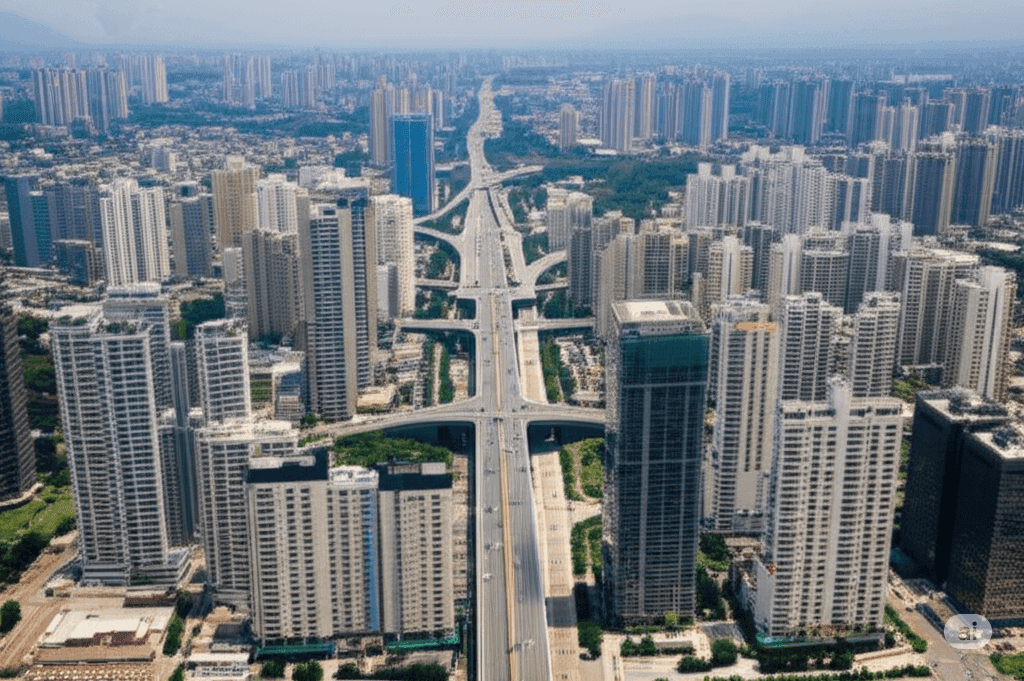
As the primary east-west corridor running from the 7th Redevelopment Zone to the Taichung Industrial Park, the importance of Shizheng Road is self-evident. However, with the continuous expansion of the Taichung metropolitan area, this corridor has become a zone of high population and industrial concentration, pushing the existing road far beyond its capacity. Severe peak-hour congestion not only degrades the daily quality of life for hundreds of thousands of commuters but also invisibly increases logistics and time costs for businesses, acting as a major bottleneck that constrains the city's overall competitiveness. Therefore, extending and optimizing Shizheng Road to expand its service area to the Taichung Industrial Park and the Precision Machinery Innovation Tech Park has become an urgent priority for urban development.
Implementation Challenges and Strategies: Forging an Efficient Transportation Network
The project's implementation is exceedingly complex and fraught with challenges. First, the dense web of underground utilities—including water, electricity, gas, and telecommunications—requires a massive and meticulously coordinated relocation effort, which is a critical preliminary phase. Second, executing construction while managing the existing heavy traffic flow demands a sophisticated and well-executed traffic maintenance plan, testing the city government's strategic planning and enforcement capabilities. Finally, effective communication and coordination with residents and businesses along the route are crucial to ensure smooth progress and minimize public discontent. In response, the project's strategy transcends simple road widening and extension. It focuses on creating a multi-dimensional, intelligent transportation system, incorporating optimized intersection signals, dedicated turning lanes, and integrated bicycle and green pedestrian pathways, all aimed at building a modern network that balances efficiency with sustainability.
Future Prospects: An Artery Driving the Economy and Vitalizing Commerce
Looking to the future, the economic benefits unleashed upon the completion of the Shizheng Road project will be comprehensive. Clearing the traffic bottleneck will directly enable manufacturers in the Taichung Industrial Park, Central Taiwan Science Park, and Precision Machinery Park to significantly reduce logistics costs, thereby boosting the operational efficiency of the entire industrial chain. The enhanced transportation will act as a magnet, attracting further investment from high-tech enterprises and talent, solidifying Taichung's status as a global hub for smart machinery and technology. Furthermore, the improved accessibility will invigorate commercial activity along the corridor. From large shopping malls to small retail shops, all will benefit from the increased flow of people, creating a brand-new "golden commercial corridor."
Real Estate Impact: Value Appreciation and a New Market Paradigm
For the real estate market, the Shizheng Road project is an undeniable and significant boon. As the adage goes, "where roads lead, wealth follows," and transportation infrastructure is a core pillar of property value. Upon completion, property values along the route and in its radiating areas are expected to experience a structural appreciation. For the residential market, the drastically reduced commute times will directly attract more owner-occupiers, especially the workforce from the surrounding industrial parks, with this robust demand providing solid support for housing prices. For commercial real estate, the formation of the new commercial corridor will drive up rents and sales prices for storefronts and office spaces. It is foreseeable that the Shizheng Road area will transform from a traditional residential zone into a high-value, mixed-use district with comprehensive functions, reshaping Taichung's real estate landscape and becoming a focal point for both investors and homebuyers.


About Rehoboth
Rehoboth is an international real estate agency with proven expertise in global property sales and marketing. Our portfolio spans 40+ developments worldwide, helping clients achieve exceptional results through strategic digital promotion and comprehensive market reach.
Learn MoreShare this article